
The operating
system behind
Pipeline.
Techxero engineers the revenue architecture that turns market intelligence into qualified pipeline, a closed-loop system for B2B teams who've outgrown tactics and need infrastructure.
- 1Market IntelligenceSignals, segments & competitive motion
- 2Ideal Customer ProfileAccounts, personas & buying triggers
- 3Buyer UnderstandingDecision maps & latent intent
- 4Messaging SystemNarrative, offer & proof architecture
- 5Qualified ConversationsLinkedIn · Email · Voice — orchestrated
- 6Pipeline GrowthDiscovery → Demo → Close, compounding
Market Intelligence
Continuous signal capture on accounts, intent, and competitive motion, the system always knows the field.
- Account universe
- Intent feeds
- Competitor moves
- Firmographic shifts
- In-market accounts
- Trigger events
- Whitespace map
ICP Engineering
An engineered ideal customer model accounts, personas, and triggers scored in real time, not in a spreadsheet.
- Closed-won analysis
- Persona patterns
- Disqualification rules
- Tier weights
- Scored target list
- Tiered cohorts
- Re-score cadence
Buyer Psychology
Decision-maker mapping, latent intent, and behavioral signals we sell to humans, modeled with rigor.
- Buying committee map
- Role priorities
- Behavioral signals
- Risk drivers
- Per-persona angles
- Objection library
- Trigger-to-message map
Precision Data
Unified contact graph, enrichment pipelines, and CRM plumbing clean inputs are the prerequisite to everything.
- Contact sources
- Enrichment APIs
- CRM schema
- Dedupe rules
- Unified contact graph
- Verified emails
- Clean CRM state
Conversation Engine
Multichannel orchestration across LinkedIn, email, and voice message-market fit tested and tuned weekly.
- Sequence templates
- Channel cadence
- A/B variants
- Reply intelligence
- Booked meetings
- Reply rate uplift
- Message-market fit
Pipeline Conversion
Discovery → demo → close instrumented end to end with reporting that reflects revenue, not vanity activity.
- Stage definitions
- Qualification framework
- Forecast model
- Loss reasons
- Stage conversion
- Cycle time
- Forecasted ARR
The operating system behind modern revenue teams.
Techxero engineers the revenue architecture that turns market intelligence into qualified pipeline a closed-loop system for B2B teams who've outgrown tactics and need infrastructure.
Five same tools per team. Few ever connect.
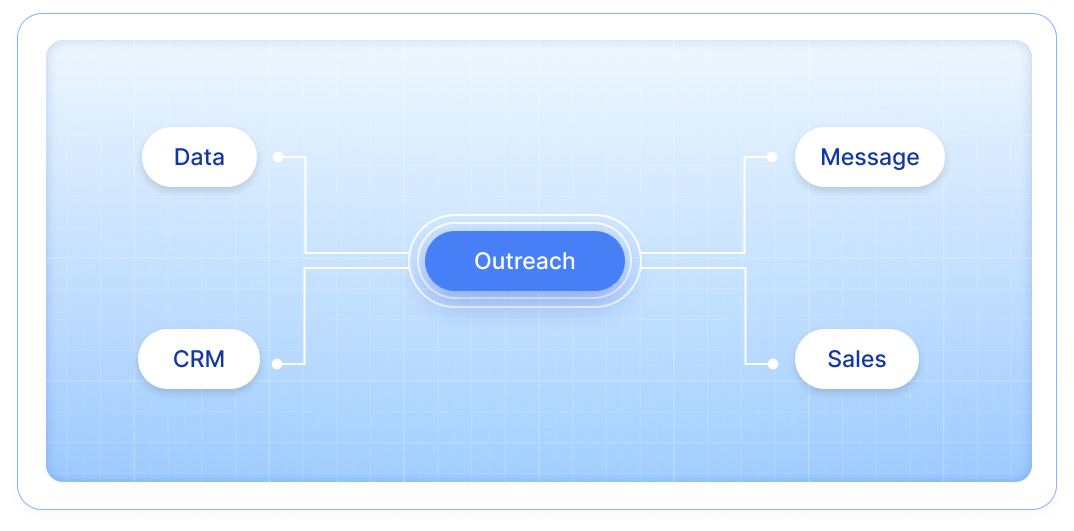
The stack you bought wasn't the problem. The absence of an architecture between the tools is.
Every team you've built — sales, marketing, ops — operates on a different version of the same buyer. Pipeline leaks where the seams are.
We don't replace your tools. We install the connective layer that turns them into one system with one source of truth.
A side by side look at the revenue function we install.
Five things change inside the revenue team during a 90 day engagement. On the left is the typical starting point. On the right is the operating model your team runs on the day we hand it back.
Pointers
Five teams operating on five versions of the truth.
Scattered across 6 tools
Best guess account list
Generic, blast templates
Unpredictable, lumpy
Activity dashboards
One revenue team running one operating model.
Unified contact graph
Scored ICP + intent signals
Personalized at the buyer level
Predictable, compounding
Revenue attribution end-to-end
We don't measure activity.
We measure understanding.
Most revenue teams report on what they did. The teams we install report on what they know the four dimensions that decide whether a quarter compounds or repeats.
ICP Clarity
The accounts most likely to buy, ranked, with the triggers and personas that put them in market this quarter — not a wish-list.
Buyer Intelligence
Decision-makers mapped, latent intent surfaced, behavioral signals modeled. We know what they care about before we open the conversation.
Conversation Quality
Every outbound touch is informed by the account, the role, and the moment — message-market fit measured weekly, not assumed.
Pipeline Velocity
Cycle time, win-rate, and deal size moving in the right direction every cohort — because the inputs upstream are engineered, not improvised.
Named clients.
Audited numbers.
A selection of signals from engagements on file. Full briefs, scope, and quarter-by-quarter cadence live in the case-study room.
Four modules. One
operating standard.
Revenue Infrastructure
ICP engineering, buyer intelligence and pipeline execution installed in 90 days for B2B teams past founder-led growth. $50–150k.
Conversation Engine
AI personalization, multichannel sequencing and reply intelligence 60-day install for teams with activity but no qualifying system. $40–90k.
Brand & Demand Systems
Brand identity, lifecycle automation and demand generation engineered as one compounding system for DTC and consumer brands. $50–120k.
Product & Application Systems
Websites, internal tools and apps production grade, instrumented from day one, handed over with the repo and the runbooks. $30–120k+.

The team that pitches is
the team that operates.
I'm Vishesh Nagar, founder of Techxero. After a decade operating revenue teams, I built this studio around a simple rule: we only sell the systems we run on ourselves first. No account managers, no junior layers: senior operators on keys from kickoff to handover.
"We don't sell decks. We install the system, run it for 90 days, then hand you a machine that compounds without us."
Working memos from inside the system.
- REV.INF · Field NotesA practical guide to Revenue Operations — what it is, why it matters, the four pillars that make it work, and how to build it without hiring a 20-person ops team.
- LinkedIn Conversation ArchitectureField notes on the conversation engine: the targeting, sequence, and offer logic that turns cold LinkedIn profiles into briefed sales meetings.
- Cold Email Deliverability InfrastructureTwelve sending-infrastructure checks we run before any campaign goes live. Inbox placement is the ceiling — no copy survives bad infra.
If your pipeline isn't predictable,
you don't have a revenue system.
A 30-minute system audit. We map your current architecture, identify the leaks, and tell you directly whether we can fix them.